
When trying for a baby, attention is often focused on hormones, ovulation, ovarian reserve or the quality of the semen analysis.
But one essential element is still too often overlooked: chronic stress.
Yet fertility does not depend only on the ovaries or the testes. It rests on a subtle balance between the hormonal system, the nervous system and blood circulation.
In this article, we will look at why stress can affect fertility and, above all, how to address it effectively.
How does stress affect fertility?
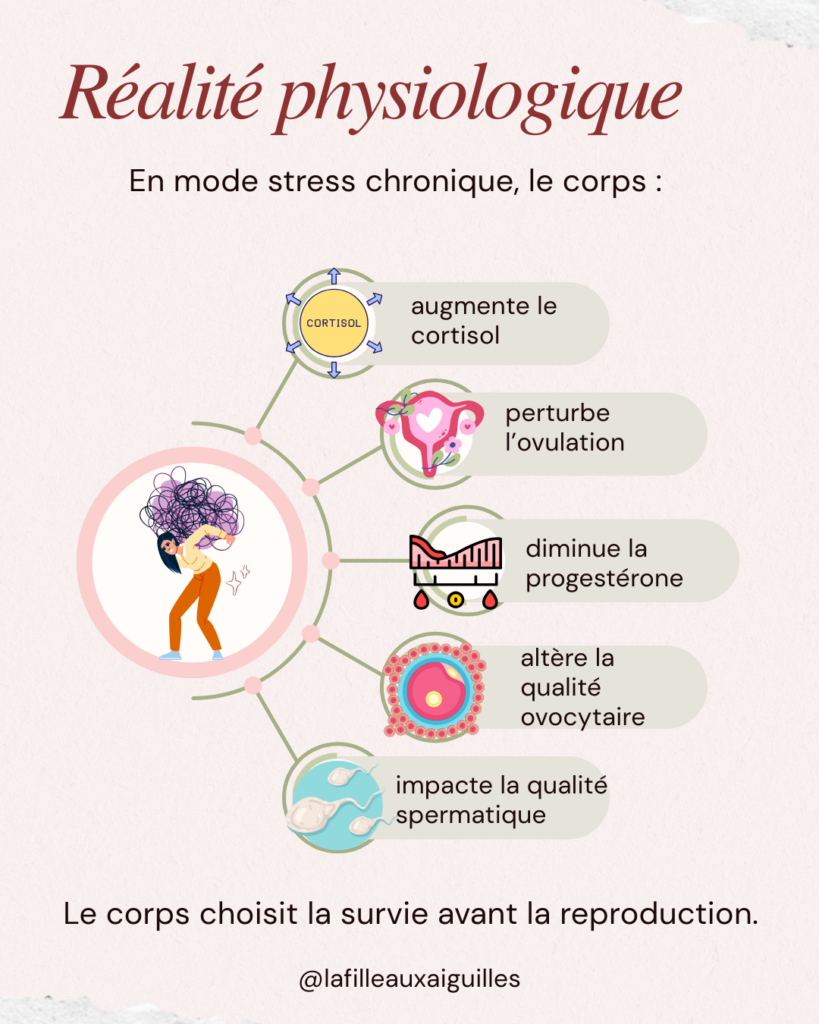
When stress becomes chronic, the body permanently activates the hypothalamic-pituitary-adrenal axis, which is responsible for producing cortisol.
This mechanism is useful in a one-off situation.
But in the long term, it can disrupt reproductive balance.
In women
Excess cortisol can:
- Disrupt communication between the brain and the ovaries
- Delay or block ovulation
- Reduce progesterone production
- Worsen premenstrual syndrome
- Alter the quality of the luteal phase
- Affect the blood supply to the uterus
When the body perceives a state of alert, it does not prioritise reproduction.
In men
Chronic stress can also:
- Impair sperm quality
- Reduce sperm motility
- Influence sperm DNA fragmentation
Male fertility is also sensitive to emotional and nervous state.
Why is stress underestimated during assisted reproduction or when trying for a baby?
Because it is often played down.
People frequently hear:
“You just need to relax.”
But without practical support, this instruction can make people feel guilty.
The stress of the medical journey, the waiting times, the tests or repeated failures is real.
It deserves specific care.
Acupuncture and fertility: support for the nervous and hormonal systems
Acupuncture is now used alongside natural conception or assisted reproduction (ART).
In particular, it may act on:
- The regulation of the autonomic nervous system
- Lowering cortisol
- Improving blood circulation to the uterus
- The oestrogen / progesterone balance
- Egg quality
Several studies suggest that acupuncture is of interest in supporting fertility problems, notably by reducing stress and improving the uterine environment.
As part of a holistic approach, it may help the body gradually leave “hypervigilance” mode, to encourage conditions more favourable to conception.
The value of osteopathy when trying for a baby
Osteopathy complements this care by working on:
- Tension in the pelvis
- Uterine mobility
- The diaphragm (a key area for regulating stress)
- Pelvic circulation
A more mobile pelvis and better circulation may support reproductive function.
Complementary techniques: breathing and yoga
Deep breathing and some yoga practices activate the parasympathetic system, which is responsible for rest and recovery.
They help to:
- Improve heart rate variability
- Reduce nervous overactivation
- Regulate emotions better
- Improve sleep quality
This work on the nervous system is often a major lever when trying for a baby takes a long time or is emotionally intense.
Fertility: a holistic and personalised view
Fertility is not only a biological question.
It is an overall balance.
Hormones, circulation, nervous system, emotional state: everything is interconnected.
Addressing stress does not mean that “it is all psychological”.
It means supporting the physiological terrain as a whole.
Are you trying for a baby in Aix-en-Provence or Cadenet?
I offer personalised support in acupuncture and osteopathy, adapted to your cycle and your situation (natural conception or assisted reproduction), in liaison with your doctor or medical team.
📍 Practice in Aix-en-Provence
📍 Practice in Cadenet
Holistic support can make a difference.